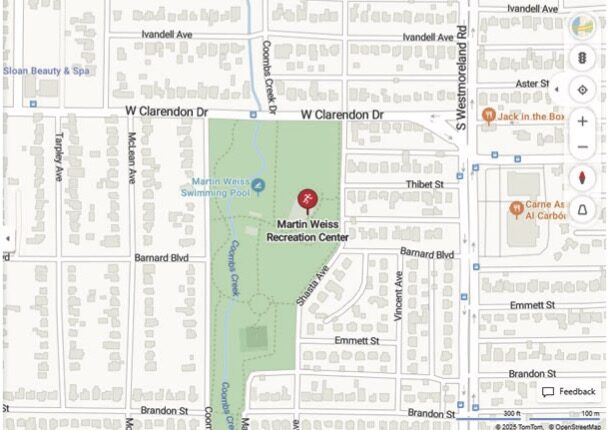
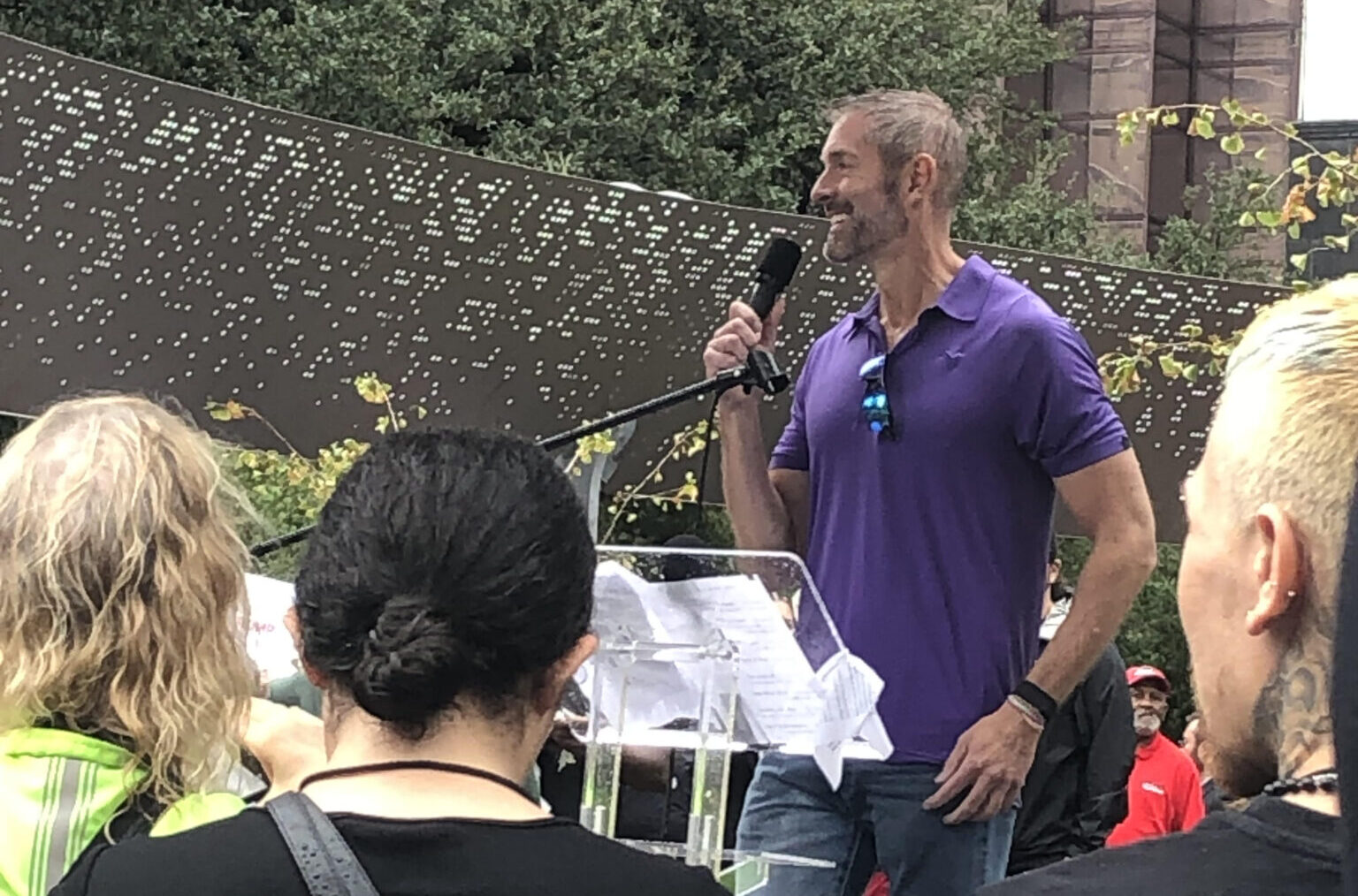
Emotions ran high Thursday during a neighborhood meeting about relocating fire trucks. About 45 neighbors met at Martin Weiss Recreation Center for a presentation from First Assistant City Manager A.C. Gonzalez about proposed changes to three neighborhood fire stations.
The proposed city budget calls for relocating ladder trucks from three Oak Cliff fire stations. The stations would retain their ambulances and fire engines, which carry water and always are first on the scene, but lose their ladder trucks. Fire fighters use ladder trucks to work on the roof of a burning building and ventilate it. Trucks also carry heavy equipment, such as the Jaws of Life tool that frees passengers from car wrecks.
The city would take one of its 22 ladder trucks out of commission under the reorganization plan. Gonzalez says the changes would save he city $2 million a year. But Oak Cliff’s City Council members say they doubt that figure.
The changes are as follows:
The ladder truck at Dallas Fire Station No. 49, at 4901 S. Hampton, would move to Station No. 46, at 331 E. Camp Wisdom.
The truck from Station No. 26, at 3303 Sheldon, would move to Station No. 52, at 2504 Cockrell Hill Road.
And the truck from Station No. 15, at 111 E. Eighth, would move to Station No. 33, at 745 W. Illinois.
The other station affected is No. 19, in Lakewood.
In May, the city analyzed its fire-and-rescue system, using computer software that other major cities, including New York and Los Angeles, have used to make their systems more efficient. It was the first time in 25 years the city had done such an analysis.
The changes, Gonzalez said, would save the city about $2 million a year, and they would increase average response times by 3 seconds. The city would have to spend money on construction to build new garages to house the trucks at the other stations, plus there would be moving costs. Gonzalez says the savings would outweigh those costs.
But how the changes would save the city money is murky. Gonzalez says the annual savings would come mostly from overtime costs and reduced maintenance and fuel costs from the one truck taken out of commission.
The proposed 2011-2012 budget calls for hiring 200 new fire fighters, however, and that will reduce overtime costs once cadets graduate in April.
Council members Delia Jasso and Scott Griggs say they doubt the $2 million figure.
“Moving the trucks doesn’t save any money,” District 3 Councilman Scott Griggs says.
And it doesn’t make sense to take a truck the city already has paid for out of commission.
Neighbors became irritated during Gonzalez’s presentation Wednesday, and they were confrontational during the question-and-answer portion of the meeting. Neighbors said they felt the changes were “sprung on us”, and that Oak Cliff is a “dumping ground” any time the city wants to make some controversial change.
City Council has one meeting before the final budget vote on Saturday Oct. 1, and Jasso says she is asking for the budget vote to be delayed.
Griggs said the city should be adding trucks instead of taking one out of commission. He noted that Station No. 12 at 7520 W. Wheatland, which is in his district, has no truck. And the nearest DFD truck is miles away. Problem is, the city has no money for a new truck.
He asked neighbors to read the city’s budget proposal. And if they should see something that could be cut, or if they find a way to save money, email him: scott@griggsfordallas.com.
Plans are coming together for redevelopment of the 48-acre Parks and Wynnewood apartments. The developer met with residents and neighbors Wednesday to review plans for an 8-acre section of the development, intended for senior housing.
Banc of America owns the property, which can only be developed as low-income housing because of a government deed restriction known as a Land Use Restriction Agreement, or LURA. But the owner has agreed to ask the Texas Department of Housing and Community Affairs to release the LURA on a portion of the acreage, which could then be developed for market-rate housing.
Banc of America also will give the city $125,000 so the City Design Studio can study the development and the Wynnewood Shopping Center to develop guidelines for sustainable development in the Wynnewood area.
The 8-acre senior housing is the first part of the Parks at Wynnewood to be redeveloped, and the project must be complete by the end of 2012. The new apartments will be of two or three stories with balconies and improved overall design. The plan is to redevelop the entire 48 acres over the next several years.
The current apartments were built in the ’60s, and residents say the boxy old apartments have no closet space, no drawers for silverware in the kitchens, and breaker boxes are placed prominently in the center of living room walls. While the new apartments are under construction, current residents will be relocated to other parts of the complex.
So far this year, crime in every major index the the city measures is down from the same period last year, except for one: residential burglaries are 0.3 percent higher (from 10,003 in 2010 to 10,029 this year), according to a report from police Chief David Brown to the city council’s public safety committee.
Overall, from 2003 to 2010, crime in Dallas has fallen 48 percent, Brown told the committee Monday.
The DMN reports that overall crimes measured fell from 50,730 last year to 48,533 during the same period this year, a drop of 4.3 percent.
Reported violent crimes include murder (down 4.9 percent), rape (down 16.3 percent), business and individual robberies (down 13.3 percent) and aggravated assault (down 5.9 percent.
Reported non-violent crimes also dropped: auto thefts dropped 9 percent, general thefts fell 3.9 percent, and burglaries fell 0.2 percent (even though residential burglaries increased slightly).
The police report that overall crimes have fallen from 93.28 per 1,000 residents in 2003 to 56.06 crimes per 1,000 residents last year, with violent crimes per 1,000 residents falling from 13.71 to 7.01 during the same period.
And just in time for good weather. The $8 million updates at Stevens Park Golf Course are right on schedule, and a grand opening is planned for Oct. 10.
Arlington-based Colligan Golf Design reconfigured the course to provide better views of the Dallas Skyline and slow erosion at Coombs Creek.
“It is truly unique and exciting to be given the opportunity to enhance a golf course rich with tradition and history dating back to the early 1920′s when the course was first open,” Colligan stated in a media release.
The course will have new tee boxes, fairways and greens, plus 38 new sand bunkers.
The media release states: “This all new, par-70 track challenges golfers to be long from the tee and accurate to the green with a layout that now stretches 6,300 yards.”
The updates were paid using 2003 and 2006 bond money.
Oak Cliff editor Rachel Stone noted in last week’s neighborhood news roundup that controversy has arisen over zoning for the Sylvan | Thirty project on Sylvan between I-30 and Fort Worth Avenue. Then yesterday afternoon, the Fort Worth Avenue Development Group announced a town hall meeting this coming Tuesday, Sept. 13, to discuss the development.
The letter from Fort Worth Avenue Development Group president David Lyles on the group’s website opens by noting there has been confusion in the community over FWADG’s position on the project and also that “we all as a community are eager to see [Sylvan | Thirty] launched.” After skimming the letter, we couldn’t ascertain exactly where FWADG stands, so posed the question to Lyles.
“We are not in favor of the bulk of what they are hoping to change,” Lyles says. The town hall meeting announcement specifically cites an increase in height from 40 feet and three stories to 95 feet and eight stories, but that’s just one problem of many, Lyles says.
Lyles says that “this is not a Sylvan | Thirty bashing meeting; there is no intention of that. … We’re not trying to gang up.” FWADG is inviting “interesting panelists who can talk about zoning and form and streetscapes and right of ways,” and tentative panel invitees are city staffers, including those from the new and much lauded City Design Studio, plus a representative from Better Block.
When we asked whether Sylvan | Thirty developers were invited to the meeting, Lyles told us, “not explicitly, but I believe they’re all aware. … We would appreciate for them to be there.”
The head of the Sylvan | Thirty project is Brent Jackson, who lives in Kessler Park mere blocks from the development site. When we reached him, he said yes, he head heard about the town hall meeting and no, he hadn’t yet decided whether to attend. In prior conversations with Jackson, he has hammered home his belief that gathering community input and creating a retail and residential project that serves such a diverse community is of utmost importance to him.
So what of this recent controversy over his project, not only the FWADG town hall meeting, but also business neighbor and Belmont Hotel owner Monte Anderson, who was once a huge fan of the project, expressing his disapproval last week to the Observer‘s Robert Wilonsky?
“As a fellow neighbor, I greatly appreciate the enthusiasm, interest and involvement that we’ve received from community groups and neighborhood associations, both from Oak Cliff and West Dallas,” Jackson says judiciously, referencing “multiple meetings with multiple groups” over the last several years.
The concern FWADG has expressed over Jackson’s recent zoning change application, filed Aug. 19, has to do with how the changes diverge from a planned development (specifically, PD 714) on which neighbors worked tirelessly for several years, and ultimately persuaded city council to approve in early 2005, Lyles says. The planned development entails a 3.2-mile stretch of Fort Worth Avenue, from roughly Beckley to Westmoreland, and encompasses somewhere around 250 acres (Sylvan | Thirty is a 30,000-square-foot project, a little more than two thirds of an acre). The 2005 rezoning converted mostly industrially zoned land to retail and residential mixed uses.
“Why rezone an area if any developer can come in and change that zoning?” Lyles asks. He stressed that FWADG “is very interested in new ideas for the betterment of the community, but there are certain sacrosanct requirements in place, which seem to be very good requirements in our minds, and we’d like to see those enforced.”
Lyles noted that FWADG has been in a number of meetings with Jackson, and “walked out thinking we had made serious headway, but apparently our thoughts were disregarded.” From Lyles’ perspective, “basically, at our last meeting, the developer suggested that was the last meeting.” That meeting was shortly before the zoning change application was filed, and Lyles says that it is a “64-page document, and a lot of hours have been devoted to going through it with a microscope and trying to, in some cases, understand the intent of the requested changes.”
Jackson says he is “embracing” the zoning process, “which, I should mention, is exactly that — a process,” he says. In addition to community feedback (the Oak Cliff and West Dallas chambers remain 100 percent behind him, according to Wilonsky), Sylvan | Thirty has worked very closely with city staff and the City Design Studio, Jackson says, and has “made many changes already based upon those respective parties’ recommendations.”
When asked about the implied wool being pulled over the eyes of neighbors in a 64-page zoning change application, Jackson points out that Cox Farms, the announced tenant of the project, “is a locally based, organically focused grocery store that has been accepted with open arms in the community.” He stops short of saying that this is no Walmart-anchored development we’re talking about. Jackson also stresses the project must meet approval from the City Design Studio, which was “put in place by some very smart and creative minds” and based on “world-renowned ideals.”
“Our project aims to be something that’s never been done in Dallas, never been done in Texas, never been done in the United States,” Jackson says. “We truly are aiming for a world-class project.” The project’s designer, Lake | Flato, is a “top quality architect in the country, recognized around the world,” and a testament to this aim, Jackson says.
And at the end of the day, a world-class project needs to be the right fit for the project’s neighbors, Jackson says.
“We have listened to the community, and we will continue to listen to the community — even after the project is built,” Jackson says. “The community will be our future customers.”
The FWADG town hall meeting takes place at 7 p.m. Tuesday, Sept. 13, at Salon Las Americas. Lyles encourages attendees to show up early because of limited space.
City Council is considering whether to sign off on tax credits for the owner of the 404-unit Parks at Wynnewood Apartments, rented to low-income families.
Banc of America Community Development Corp. wants to rebuild the apartments. But Councilman Scott Griggs says he will not support the tax credits unless Banc of America agrees to open some of the property up to other types of development.
Griggs brought this up during his campaign. How can you have a thriving retail center when it is surrounded by low-income property? For Wynnewood Shopping Center and the Wynnewood neighborhood to improve, there needs to be a mix of incomes, he has said.
Griggs called a meeting to update the community on his and City Council’s negotiations with Banc of America. The meeting is tonight, Aug. 31, at 6 p.m. at Kiest Park Recreation Center.

WIN President Susybelle Gosslee, Win co-founder Virginia Whitehill, Mayor Mike Rawlings, and Ann Moy
Last week 100 or so women dressed in all-white converged at Dallas City Hall.
They were there to honor the 91st anniversary of the passage of the 19th amendment, which gave women the right to vote.
Known as Women’s Equality Day, August 24 has been celebrated annually for more than 20 years with a program at City Hall by Women’s Issues Network (WIN), a local Dallas women’s organization, according to a spokesperson.
“The white apparel represented the suffragists who lobbied for women to vote.”
From WIN’s news release:
Mayor Mike Rawlings read a proclamation and declared it Women’s Equality Day. 12 City Council members were in attendance along with many representatives from civic and social organizations including the League of Women Voters, National Council of Jewish Women, Women’s Council of Dallas County, Dallas Women’s Museum, Peacemakers, Inc., and Delta Sigma Theta.
Susybelle Gosslee, President of WIN and a Lake Highlands resident, provided a brief history of the suffragists movement and the long 72-year struggle it took for women to be able to vote. She noted that there are still many ways in which women are not treated equally. “We have ascended to leadership positions across all walks of American life, but women still only make 81 cents on the dollar compared to men,” she said.
The featured speaker was Katie Sherrod, a journalist who was among the first women to move into significant management positions on a Texas newspaper when she was named the metropolitan editor of the Fort Worth Star Telegram.
Sherrod provided a powerful story of the equality struggles women still face. “Birth control pills were introduced 50 years ago and only now will be covered by medical insurance in 2012. Viagra was covered by insurance shortly after being introduced to the public in 1998,” she said. “Women are still not being treated equally.”
In related news, the Women’s Museum, 3800 Parry Ave. at Fair Park will have a women’s equality exhibit on display through September 2.
• Below is a fascinating article from the early 1900s about women fighting for the right to vote. Zoom in to read.
Dallas Morning News article, 1912
Article copyright 2004, The Dallas Morning News
This may come as a surprise to you, but according to a city survey of streets, about 83.2 percent of them are in “satisfactory” condition, according to Rudy Bush in the DMN. (Note my earlier post mistakenly implied the city had surveyed residents; instead, they surveyed the streets.)
The good news, Bush points out: In 1994-95, 62 percent of streets were “satisfactory.” The bad news: Satisfactory streets in recent years peaked at 86.7 percent in 2009 and seems to be headed downward, if my car’s struts and tires are to be believed.
They’re the components of the car that get an up-close-and-personal look at the potholes, cracks, creases, dips and bumps on many of our city streets now. In fact, our son and I just completed a 4,100-mile college-hunting trip through a bunch of midwestern and eastern states, and we rode on all kinds of highways, roads and streets, and without any proof to back this up other than the shuddering of our car, the streets around here seem to be worse even than those in New York City.
Why we were driving straight through the heart of Manhattan is a story for another day, but we both agreed that NYC’s streets have it all over the one in front of our house in terms of being well-maintained.
No worries, though — the city can afford to spend about $120 million to improve streets next year, which is pretty darn close to the $950 million the city knows it needs to spend to resolve street issues throughout Dallas. Our street problems should be over soon.
Want to get a better grasp of zoning laws? Strengthen a neighborhood coalition? Work more effectively with code enforcement?
The Dallas Homeowner League’s 13th annual boot camp Saturday will cover those topics and more. The boot camp is from 8:15 a.m.-noon Saturday, Aug. 20 in the City Council chambers, on the sixth floor at City Hall. The class costs $10 for the first member of a neighborhood association and then $5 for additional members of the same group.
Mayor Mike Rawlings will give the keynote address, and council member Angela Hunt will give a talk about the Dallas Bike Plan. From 10 a.m.-noon, there are workshops on organizing a neighborhood group, how the new TABC rules might affect your neighborhood, how to run a neighborhood meeting and crime watch.
More information, including registration, is available on the Dallas Homeowners League website.
Before we get into a gold-rush mentality, let’s take a step back and think about this for a moment. That was the advice West Dallas resident Julian Fernandez had for the city’s gas drilling task force Tuesday night.
City Council member Angela Hunt appointed the panel, composed of several lawyers, an environmentalist and experts in the oil and gas industry. Their task is to research urban gas drilling and hydraulic fracturing, which is known as fracking, and decide whether and under what circumstances the city should allow drilling. The city signed a $34 million mineral lease with XTO Energy in an effort to balance the budget two years ago. But so far, the city has not given XTO a permit to drill on its lease in the Mountain Creek area. If the city doesn’t allow the company to drill, we must repay the $34 million.
Overwhelmingly, neighbors urged the panel to ban gas drilling because of evidence suggesting that chemicals used in fracking can contaminate ground water and pollute the air. Th Environmental Protection Agency does not regulate fracking, which utilizes cancer-causing compounds including benzene. So the job is left to the Texas Commission for Environmental Quality, which employs 12 inspectors for some 15,000 gas wells throughout the state.
City Council members Scott Griggs, Delia Jasso and Dwaine Caraway attended the public forum. Presumably, the remaining 11 members attended Mayor Mike Rawlings’ private dinner with city council members. (Not only was it scheduled on the same night as one of only two public meetings on gas drilling, but it also was closed to reporters, despite there being a quorum present, but that’s another story.)
“They’re not going to have fracking where I live,” said Joanne Roan of Bryan Place. “Or in Lakewood or in most of our neighborhoods, but I feel for people who do.”
Fracking also requires hundreds of gallons of water, a precious resource itself.
Molly Rooke, who lives near Mockingbird, suggested the panel wait until there is more research and better technology for extracting the gas from the Barnett Shale.
“That gas is not going anywhere,” she said. “It’s going to be there. Someday there could be a better technology, and we don’t want to make our air quality worse.”
Two people spoke in favor of gas drilling in the city. Robert Unger of University Park, who said he worked in the oil and gas industry for 35 years, said he thinks fracking is safe, even near “established and mature developments.”
We all need energy, was the gist of his argument. Wouldn’t it be nice to pay less for it?
The panel’s chair, Lois Finkelman, told the room: “I promise you we will address this the best we can, and when we finish, we will have a strong consensus about what to do.”
The next public meeting is in October, a few days before the panel submits its recommendations.