Photography by Jenni Cholula
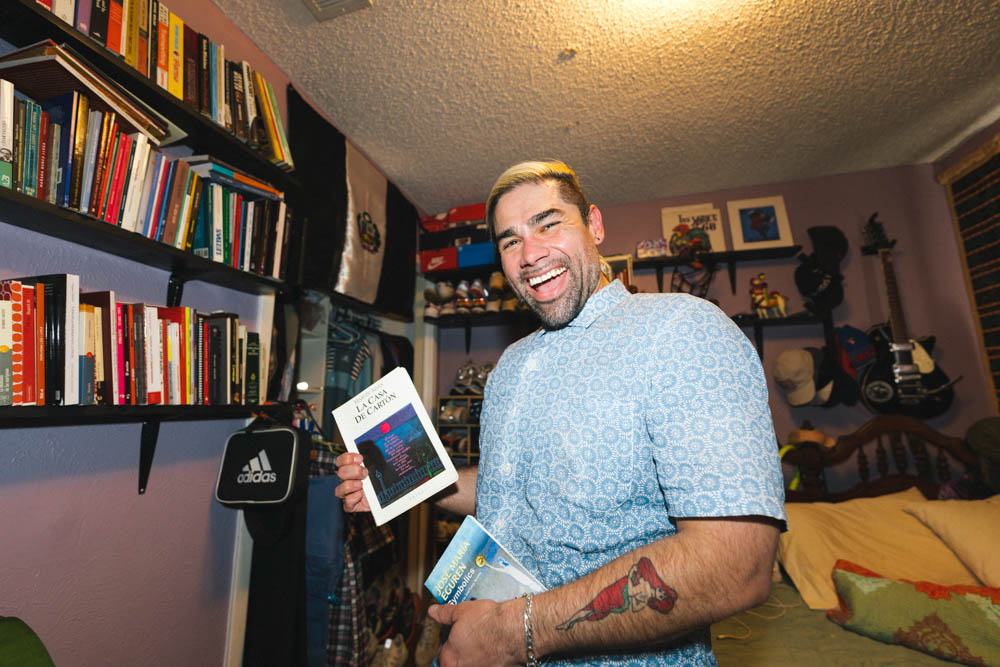
“This is one of the quintessential Peruvian novels from the 20th century,” says Jose Garay Boszeta about Martín Adán’s 1928 book, The Cardboard House. “The interesting thing about the book is that he starts subverting the language. It’s a very conscious attempt to go against the structure of Spanish, but also against tradition.”
Adán was a poet who wrote the book when he was just 20-years-old. It’s hailed for its avant-garde storytelling, and for its visceral exploration of Barranco, an artistic haven located in Lima, Peru. Adán was Peruvian himself, and structured the book around an anthology of scenes based on his own experience as an artist in the country.
Boszeta was from a nearby area in Lima. He studied philosophy at San Marcos National University, one of Peru’s most prestigious institutions, before moving to the states at 22.
“I started having deep conversations with my dad when I was 11,” Boszeta says. “I was very inquisitive. When I discovered -isms, I wanted to know what all those things were. So I started asking my dad, ‘What’s anarchism? What’s Marxism?’”
His father was an economist, his mother a school teacher. When they noticed Boszeta’s interest in intellectual topics, they purchased him a Spanish Encyclopedia Britannica and sent him to local libraries.
“I was obsessively reading the encyclopedia at a young age,” he says. “Then I started reading novels because of conversations with my dad.”
Boszeta first read The Cardboard House when he was 16.
“I was blown away by it,” he says. “It’s one of the books that I always had. When I moved here, I brought five books and that was one of them.”
In 2012, publishing company New Directions released an English translation version of The Cardboard House, which Boszeta purchased and re-read.
“I was dissatisfied with the choices of the translator,” he says. “I felt that it flattened the language and missed a lot of language cues and historical facts. As I was reading, I was thinking, this should’ve happened like this, this should’ve been like that. I thought that I could do better, not only because I’ve read it so much but because it’s directly from the place I’m from.”
One error stood out to Boszeta.
“The original makes reference to a Peruvian President named Ramón Castilla, who abolished slavery in Peru much like Lincoln,” Boszeta says. “But the translator thinks it’s Castile, the city in Spain. It’s an honest mistake, but changes the meaning completely. It’s errors that come from not enough familiarization with the context from where the book comes from.”
With Boszeta holding The Cardboard House in such high regard, the mistakes were a tragedy, but one that he could fix. The solution? Publish his own translation of the book, informed by his upbringing in Peru. Adán had no familial heirs, meaning that his work went into the public domain following his death in 1985.
Boszeta spent his days translating the book in 2018, spending his nights bartending at The Wild Detectives. By late 2019, he was ready to self-publish his version. He asked the bookstore bar’s management about hosting an event to sell copies of the book, and they were all for it.
“They were so excited for me,” Boszeta recalls. “They didn’t take any cut from the book, and it was very successful. I published it with no logo or anything, just 250 copies. They sold like hotcakes.”
Boszeta suddenly realized the potential in front of him. There were countless Spanish books that had never been translated properly, and countless more that had never been translated at all. He needed a brand.
Dulzorada Press was born in 2020, its name described as a polysemic neologism; a word composed from bits of multiple words all with different meanings. It combines the Spanish words dulzor (sweetness), luz (light), dorada (golden) and rada (harbor) into a singular word. Dulzorada was first coined by Peruvian poet César Vallejo in 1922.
Since its inception, Dulzorada has published 11 translated books, with three from Boszeta and the rest from Spanish freelance translators.
“I never really thought of being a translator or being a publisher,” Boszeta says. “I wanted to be a writer.”
But once immersed, Boszeta realized how much he could do with the medium.
“There’s so many possibilities,” he says. “There are many styles. No translation supersedes another.”
The latest Dulzorada release is Paciencia Perdida, a fiction anthology featuring short stories from some of the most acclaimed modern Peruvian authors.
“Sometimes I feel like a complete fraud,” Boszeta says. “I don’t think I will ever finish learning English, but I don’t think I ever finished learning Spanish. The depth to language is endless.”