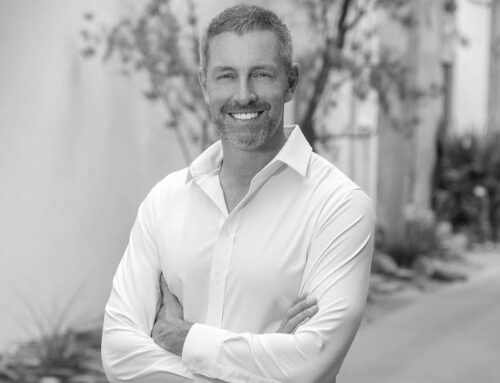
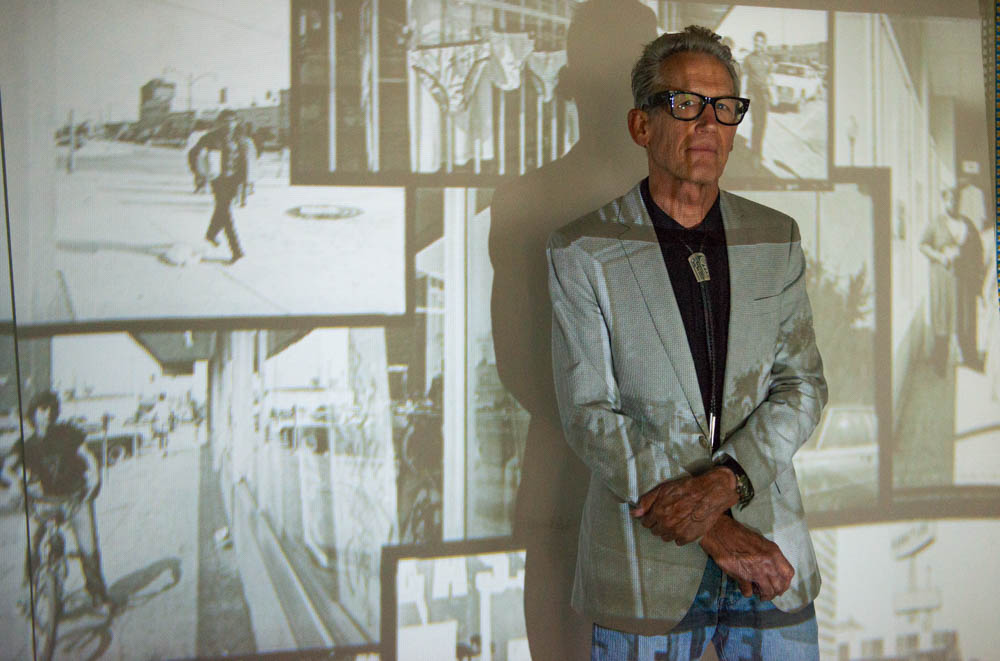
Photo by Lauren Allen
At age 10 in 1961, with his father’s costly German camera, Richard Doherty took his first photograph.
In his house growing up, Doherty’s father had a darkroom built into the house where he taught him how to process film and make prints. Doherty’s father was infected with the hobby of photography, and soon he’d catch the bug as well.
“It’s my obsession,” Doherty says. “Art is an addiction, and it’s fatal. And I’ve got it.”
As a doctor, his father did not have time to continue the hobby, but Doherty picked up right where he left off. In high school, he bought himself a good camera to take photographs but didn’t take it too seriously.
Doherty got his undergraduate degree in psychology and did not take a photography course until his graduate studies.
Doherty moved to Fayetteville, Arkansas for school where he befriended Michael Peven, who went to the School of the Art Institute of Chicago (SAIC). Peven was the first MFA photographic artist to move to the state and he established a photo program. While Doherty didn’t take any of Peven’s classes, the two became close and developed a mentorship relationship.
Doherty was accepted to the MFA graduate program at the SAIC where he studied and taught with Ken Josephson and Joyce Neimanas who both helped him develop his aesthetic and teaching sensibilities.
In 1980, he graduated from SAIC and was hired as a photography professor at Louisiana State University a year later. In 1982, he accepted a professorship at Tarrant County College in Fort Worth and retired as emeritus professor in 2016.
Doherty began photographing our neighborhood upon moving here in 1983. He captured the world around him whether that was his kids, neighbors or total strangers.
“I started photographing almost immediately because it’s a fascinating neighborhood,” Doherty says. “The photographs are just kind of a survey of that. I liked the neighborhoods, I liked the yards. I liked the streets, the Jefferson Boulevard strip, I liked the detritus and evidence that people live as they want to live their lives.”
Doherty has a classic style with a focus on street photography, and says he would “rather sell washing machines than do commercial photography.”
“I don’t fiddle around with any kind of techniques, goofy filters and all that stuff,” Doherty says. “I see something, it fascinates me and I photograph it. It puts it into my context and my point of view.”
About three years ago, Doherty was approached by the University of North Texas Press, and the head of collections wanted to display his work.
Doherty offered to donate his work, but after the idea for a book was brought up, he got started on a proposal. The book would be a visual diary of his beloved Dallas neighborhood titled Framing Oak Cliff.
“This is a slice of life. This is my reality,” he says. “This is my version of life in this beautiful part of the city.”
He hopes to convey the beauty and uniqueness of the area.
“We’re divided from the rest of Dallas by the Trinity River, and because of that, the developers did not come around,” Doherty says. ”It was an ethnically and racially mixed, economically mixed, and a beautiful kind of melting pot of a city. And that’s what I like. I like a city that has a pulse and soul and an interesting landscape.”
Accompanying the black-and-white photographs is a concise history of Oak Cliff by bestselling author Bill Minutaglio, as well as essays by curators John Rohrbach of the Amon Carter Museum and Christopher Blay of the Houston Museum of African American Culture. These essays provide context for the photographs and anchor them in the landscape of contemporary photography.
“I feel like it really works, and I think if those essays weren’t there, the photographs wouldn’t be as effective,” Doherty says. “If people read the essays, and look at the work, they’ll really understand what’s going on.”
The placing of photographs throughout the book is intentional, and all work together to tell the story of the neighborhood.
“If you look through a carefully done book of any kind, you should be able to read one photograph and that should tell you something about the next photograph,” Doherty says. “There should be a train of thought throughout the book. It’s not just a random dump of images. They’re carefully arranged.”
While Doherty’s work has been displayed across the nation and he has had collections at several locations including the Amon Carter Museum, the Arkansas Museum of Fine Art, and the Art Institute of Chicago, this is his first publication.
“This is a real important body of work. All this stuff is really personal,” Doherty says. “It’s a very rewarding thing. I’ve been doing all this stuff for so long, and I may have made thousands and thousands of photographs. I had to condense what I thought would make a cogent body of work represented in this book and that was a challenge. It took two and a half years, but it worked.”
The book is available through several online sellers such as Amazon and Barnes & Noble, and is on shelves in an array of stores in North Texas including Whose Books, Interabang Books and The Wild Detectives.