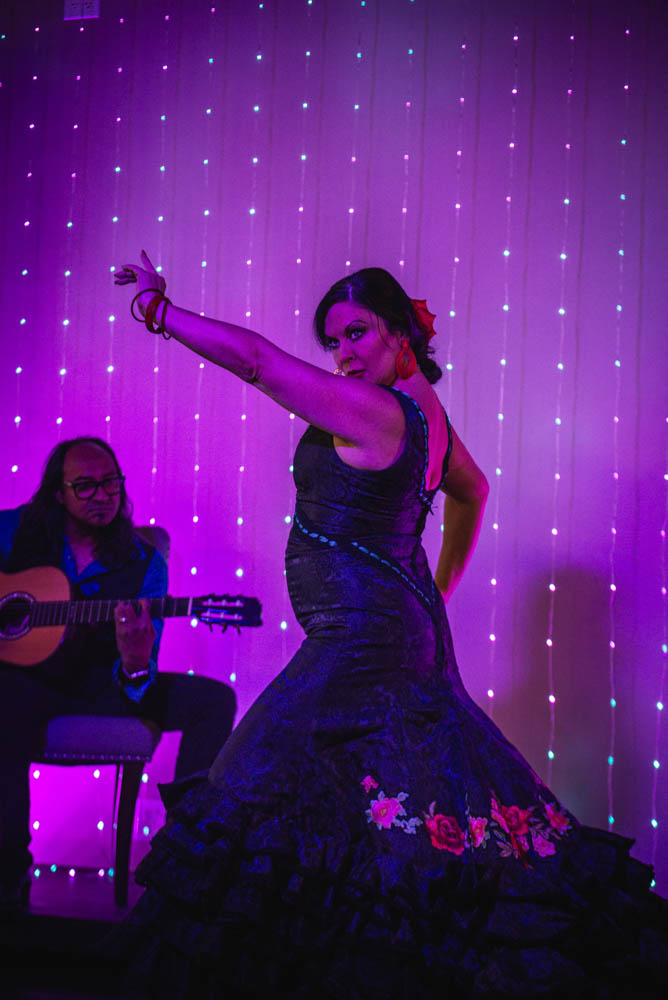
In Flamenco, a solo dancer or group of dancers don vibrant dresses and thick boots with nails fastened to the bottom. They’re accompanied by an acoustic guitar player, at least, but oftentimes a full band. The nails on their shoes create a sharp clicking sound, which the musicians follow.
Flamenco remains popular in select regions of Spain, but its American crossover appeal is lacking, at least according to Julia Alcántara, executive director of Dallas-based troupe, Flamenco Fever.
Alcántra has been performing Flamenco for 25 years. In 2015, she made the transition to teaching and spearheaded a series of annual Flamenco festivals in Dallas. The Fever traveled across Texas and the country for performances, with over 70 in 2024 between dance halls, opera houses, the back corners of restaurants or even out on the street.
The group can seem prolific, but it doesn’t feel that way to Alcántra. To her, Flamenco is being stifled. It already faces an uphill battle towards mainstream popularity given its niche, especially one that tends to lean towards an upper middle class demographic due to increasing prices for lessons and proper materials. It’s also becoming harder for them to find places to rehearse, with some places not offering dance studios and others forcing Flamenco out altogether due to the nails scratching up their floors.
“Most of the cultural centers in Dallas don’t have a dance space,” Alcántra says. “The Latino Cultural Center should have a dance studio. We had one at the Oak Cliff Cultural Center but they redid the floor and said no more dance classes. What is this place for if we can’t do our art from here in Oak Cliff?”
Nevermind the tradition, Alcántra wants to make the historical values of the medium contemporary.
“It glorifies the Hispanic heritage of Oak Cliff,” she says. “It gives them something to be proud of in the face of all this gentrification, and I think it’s important that we preserve that.”
Since its inception, the Flamenco Fever has been a nomadic enterprise. Earlier this year, an opportunity arose to change that. After a chance meeting with a developer, Alcántra was made aware of a 4,600 square foot space in a shopping center on Westmoreland Road, right in the heart of Oak Cliff. She jumped at it.
La Cantera Arts Conservatory was born in October, complete with its own brand new dance floor for lessons and performances. In addition, Alcántra has made the space available for private parties developing a scene for Flamenco in Oak Cliff.
“We are wanting to take a breather,” she says. “We’re hoping this place will be a nice home for us.”
La Cantera received a $14,000 grant from the City of Dallas’ Office of Arts and Culture. They’re planning to use this funding to offer more affordable beginner classes and launch a programming calendar this spring. Currently, beginner classes are offered four times a week, for $100 a month. Alcántra says she’d like to implement a limited time $5 class program.
As for the trepidation from people who would want to try but might not be familiar with Flamenco, Alcántra doesn’t mince words.
“Did you know how to swim? Did you know how to drive?” she asks. “You had to go and learn how to do it. Dance is the same. And it’s fun when you’re around other people and everybody is doing it together.”
To Alcántra, that’s what it’s all about. The shared connection that can only be found at the intersection of music and movement.
“The isolation of the digital age is just killing people, emotionally, mentally, spiritually,” she says. “We want people to come and do something other than sit on the couch and watch other people do stuff on TV. Turn off Dancing With The Stars, get over here and get on the dance floor.”
Full event schedule lacanteraartsconservatory.com