Photography courtesy of the Dallas Zoo.
Photography by Lauren Allen
Photography by Lauren Allen
Photography courtesy of the Dallas Zoo.
Photography by Lauren Allen
Photography by Lauren Allen
There was a point in Lisa New’s life where she spent her dusks and dawns in a little dingy boat off the Hawaiian coast studying spinner dolphins’ behavior as they rested in shallow waters after feeding overnight. Unlike the bottlenose dolphins that jump out of the water in arches, the more acrobatic spinner dolphins shoot straight up into the air.
“One would jump out of the water and spin, and then another would and another, and then all of a sudden, it was a symphony of animals all around you. And in just the blink of an eye, and almost silently, they were gone,” she says.
New had never flown on a plane before she went to Hawaii for that internship.
The next year, she was tracking humpback whales migrating from Australia to Hawaii with the Pacific Whale Foundation. She was doing population census work by photographing their flukes (the big tail at the back) and distinct markings on their dorsal fins. This was before digital technology, so the team would spend hours analyzing and comparing photos.
New grew up frequenting lakes in Tennessee near the Great Smoky Mountains and loved being in the water. In rustic fashion, the team would camp on the beach. One venture into the ocean, their small boat capsized, tossing their equipment and the crew into the water.
“It might sound glamorous. It was really tedious hard work out in the Australian sun. But it was incredibly rewarding,” she says. “And I was happy as could be just to be out on the water every day looking at and being close to those animals.”
New’s love of animals wasn’t innate.
Her fascination with evolutionary biology and animal behavior began during undergrad at the University of Tennessee. Her family had dogs, a barn cat, and she occasionally spent some time with horses.
“My career trajectory toward working with animals was really about their behavior and how animals evolve and adapt to their environment,” she says. “And then along the way, I fell in love with all the animals.”
A first-generation college graduate, she comes from a close-knit family of tradesmen. Her father was a journeyman pipe fitter and an amateur country musician, and her mother was a homemaker.
“My parents used to say that they would just put me to sleep on a pile of coats, and I would sleep there until it was time to go home at night, and if I started crying, I would always stop when the fiddles played.”
Despite her many afterschool activities, cheer, softball and student council, New made sure to see her grandparents regularly after school and on the weekends. One of her grandmothers did alterations for JCPenney.
“That was incredibly important to my grandmother that I go to college,” New says. “She had saved up all of her dimes and nickels over the years, and she wasn’t alive when it was time for me to go to college. But you know, there was a small nest egg for me to get me started on my way.”
Her brother died in a tragic fire when he was 18 years old and New was 21. Unbeknownst to New, he had made her the beneficiary of a life insurance policy.
“Him doing that changed the trajectory of my life,” she says. “I grieved a lot, and I considered dropping out of school just because I was such a mess. But I decided to stay in school and to use the money for something that he would have wanted for me.”
That’s when she headed to Hawaii and Australia. When her money ran out, she returned to Knoxville, where she was born and raised.
While waiting tables, she volunteered at Zoo Knoxville in the behavior and research departments. About this time, an opportunity to study orca whales was offered to her, but she just couldn’t afford it. Plus, her interest had shifted from marine biology.
She was eventually offered a full-time position in the research department. One of her tasks was caring for two orphaned chimpanzee babies, Mugsy and Lou.
“That also changed the trajectory of my career. I went from thinking that I wanted to be in academia and study evolutionary biology, probably focused on marine mammals to this love and fascination with great apes and particularly chimpanzees,” she says.
She went back to graduate school for a Master of Science in ethology, where she completed a practical small sample study of how to reintegrate the two chimpanzees back into a troop.
New then spent the next 30 years at Zoo Knoxville, shifting from conservation science to leadership. She has spent 20 of those years involved in the Association of Zoos and Aquariums (AZA), an accreditation and conservation organization for 238 institutions globally.
New met Dallas Zoo’s former CEO Gregg Hudson in the early-2010s when she came to Dallas as an accreditation inspector five years after the zoo had been shifted from being a City-run organization to a privatized 501(c)(3).
Fort Worth Zoo-alum Hudson took the Dallas Zoo from being a struggling institution to financial solvency and increased yearly attendance to one million visitors.
“The change during that five year period was remarkable,” she says. “It really touched me at the time.
When she got back to Knoxville, she put her name in the hat to be the CEO of Zoo Knoxville, since the CEO had retired. Members of the board had already started encouraging her to apply.
“It was not a shoo-in. I was very inexperienced,” she says. “But, you know, Gregg Hudson had that kind of impact on me, and I was able to tell him that, multiple times, that, ‘You are one of the reasons that I pursued my career.’”
She was appointed as CEO Zoo Knoxville in 2013. In the 10 years she served as CEO, she was at the forefront of a $39 million capital campaign, increasing yearly attendance to more than 500,000 visitors, more than doubling the operating revenue and reconstruction projects.
Hudson and New continued to work alongside each other on various projects through AZA. One pillar of the organization is overseeing species population holistically across multiple institutions, which helps decrease selling or removing animals from the wild. It also looks at conservation in the wild through its Saving Animals from Extinction program (SAFE).
“When we work together, we’re bigger than the sum of our parts,” she says.
New helped with pushing legislation through for the 2022 Big Cat Public Safety Act, which focuses on restricting the selling and private ownership of big cats. The AZA was already working with federal organizations pre-Tiger King craze. Joe Exotic’s unaccredited Greater Wynnewood Exotic Animal Park and Carole Baskin’s antics might have accelerated some things.
Hudson served as AZA’s chair of the board in 2018. New filled that role in 2023.
When Hudson died after battling cancer in 2023, the Dallas Zoo board hired a recruiting firm that reached out to New.
It was time to leave Tennessee.
Zoo_LaurenAllen_7961
Photography by Lauren Allen
Zoo_LaurenAllen_7975
Photography by Lauren Allen
Zoo_LaurenAllen_8030
Photography by Lauren Allen
“We had built some amazing things,” she says. “I had felt like I had taken it to a point where it was ready for fresh blood, and I could turn my attention somewhere else. It’s not often in your life that you get the opportunity to shape a culture and have an impact on not just one institution, but two. So I just really couldn’t turn it down.”
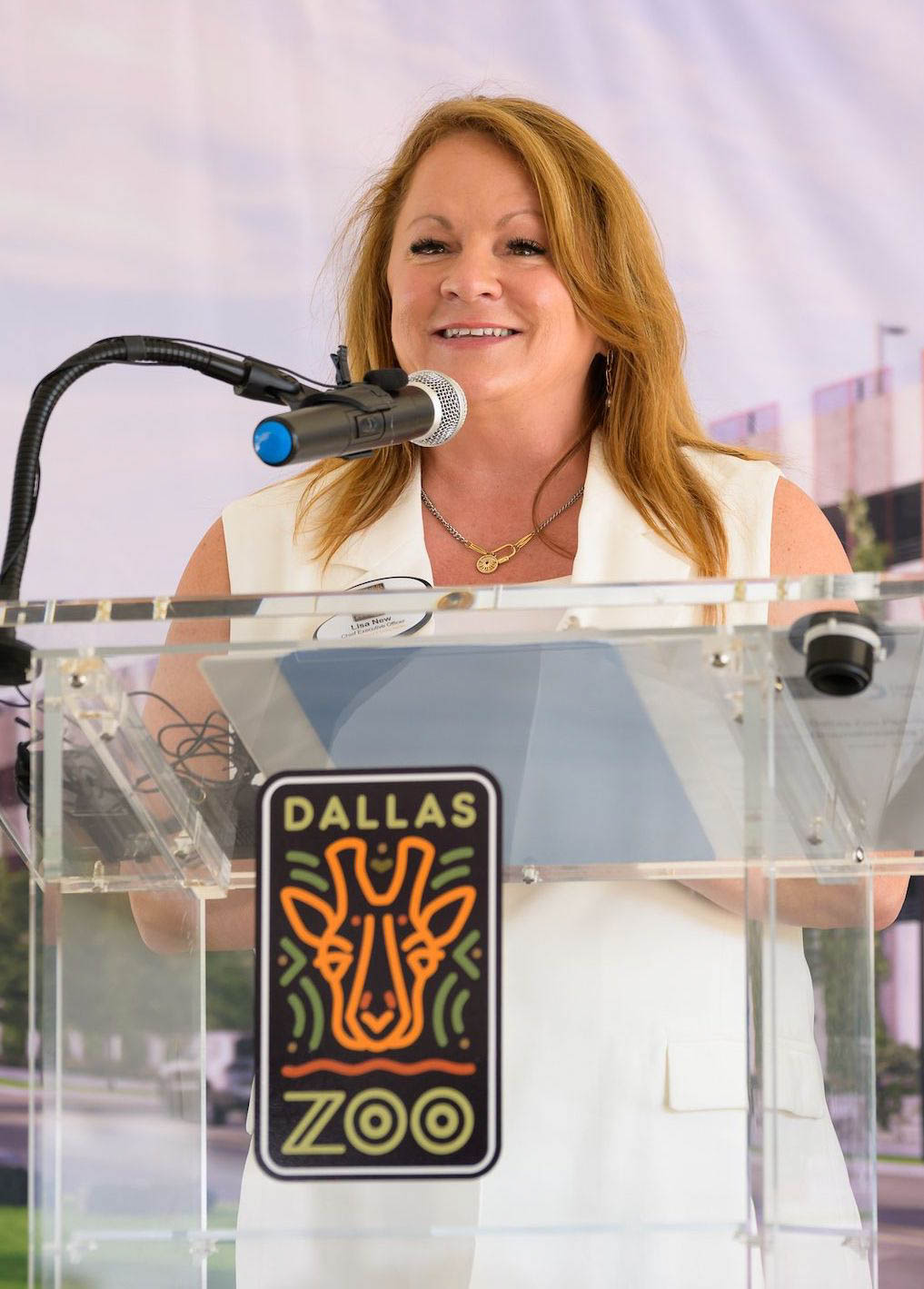
New was selected as the Dallas Zoo’s first female CEO in its 135-year existence in 2023. The organization has almost 400 employees, more than 2,000 animals
and more than 400 species on 106 acres in Oak Cliff.
The Dallas Zoo has been involved with the confiscation of wild animals, like Oak Cliff rapper Trapboy Freddy’s tiger cub in 2023.
“We’re routinely sought out and asked for our expertise in cases like this. Dallas-Fort Worth, there are more illegal animals, either in the pet trade or the illegal wildlife movement,” New says. “Dallas-Fort Worth is one of the busiest airports in the country. So, another thing that Dallas Zoo is working on is being able to be a hub for this region in wildlife confiscations.”
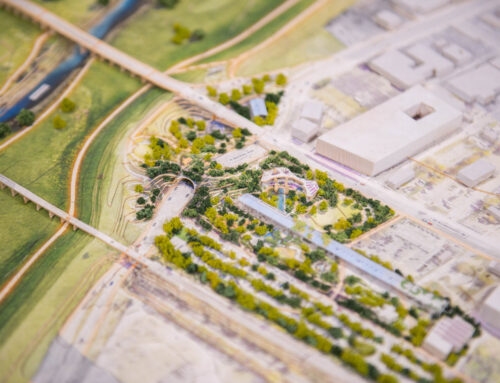
Protecting the Twelve, a conservation effort for 12 individual species across Texas and the world, is nearing its end, and a deep dive into the impact of the efforts is next. There’s capital growth and new animal exhibits, like the new I Spy Butterfly, in the works. New says the Zoo is working in close partnership with Halperin Deck Park.
“It’s been just a year and a half, and every day I’m continuing to be impressed and excited about working with them [staff],” she says.
New lives in Oak Cliff close to the Zoo. It’s the closest she can get to rolling, lush East Tennessee. She visits home often. She’ll stop by and see Lou who is still alive and in his late-30s to early-40s and resides in the Lisa New Chimpanzee Ridge. He still remembers New whenever she visits Zoo Knoxville.