
District 1 representative Chad West speaks into the mic at the front of the room with Chief Eric Roman. Photo by Victoria Hernandez.
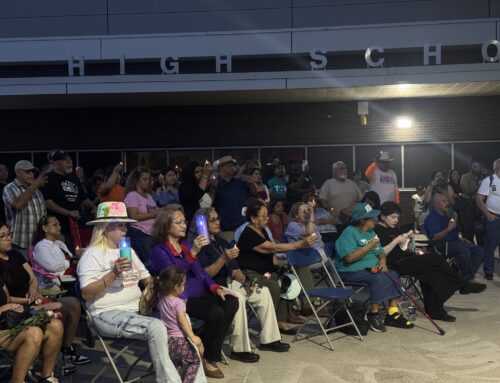
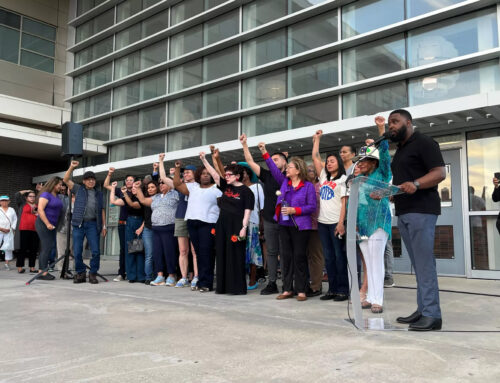
Residents concerned about the safety of their fellow citizens joined together in a crowded room Tuesday night for an open town hall at the Oak Cliff Cultural Center.
Numerous members of the Dallas Police Department and City Transportation and Public Works Department joined District 1 representative Chad West to address concerns to a room of over 50 people. The discussion was open to questions, with many bringing up the recent car wrecks in the district, including the multi-car crash in Bishop Arts that injured seven people last month.
Residents particularly raised concerns about the Tyler St. roundabout, suggesting the potential to add a stop sign or traffic signals. However, despite the nods of agreement in the audience, this may not be the ideal solution.
For federal law, stop signs and traffic signals are not a solution for traffic-calming or speeding based on research as those additions could lead to more danger for pedestrians, assistant director of City Transportation and Public Works Auro Majumdar said.
“There’s got to be some solution to this,” an audience member stated in regard to the Tyler St. speeding issue after suggesting adding speed bumps. This comment shifted the meeting to focus on the temporary solutions the city is working on, such as a new crosswalk and signage to the area as more data comes in to create a permanent solution.
Rather than strictly discussing a permanent solution during the meeting, local leaders emphasized the importance of reporting the drivers and understanding that the issue is more than a visual fix, but an individual one.
Some of these accidents are by design, but some are also solely up to the driver, Chief Eric Roman said.
“There are multiple avenues and multiple ways to try and address traffic. One of those, first and foremost, is education,” he said.
Lt. Ira Carter echoed that point, highlighting that in order for law enforcement to seek out those speeding, there needs to be accurate reporting done in addition to the 311 or 911 calls.
“Here’s the problem that we have a lot of times, if we go out there and you don’t give us the proper times, then you don’t see what you need to see,” Carter said. “The problem we have most of the time is when you guys call in, you don’t give the correct information.”
For now, in order to best address public safety, officers need individuals to continue making reports with the time of day, what day of the week, and the influx of how, when and where to better direct units to survey those concerns.