On the second day of May 1961, four newly formed congregations came together to combine the practices of Unitarianism and Universalism. And on top of the stack of charters was a church from Oak Cliff.
Photography by Lauren Allen
“Literally, we were the first ever Unitarian Universalist Church to be chartered as such in the world,” worship ministry co-chair Ian Grey says. “Because we happened to be the one on the top, of the four papers that were there that got signed that day. We were the top of the stack.”
Thirty congregation members signed the charter application for the Unitarian Universalist Fellowship of Dallas (also called Oak Cliff UU Fellowship). Today, 33 individuals are voting members on the board for what is now called Unitarian Universalist Church of Oak Cliff (UUCOC).
The formation of Unitarian Universalism derives from the consolidation of the two religions through the Unitarian Universalist Association.
Unitarianism, founded in 1793, came out of the first schism of Christianity. American Unitarians abandoned the doctrine of the Trinity (the three-part God, Jesus and the Holy Spirit) to instead move to adopt a hopeful view of humanity rather than a focus on sin, according to an article by BBC News.
“The Unitarians believed in a combination of having a unified congregation, so people of different traditions gathering together, in questions, very humanist in its approach still with a Christian aspect to it,” Ian Grey says.
Universalism developed following dissent from the Baptist and Congregational churches, according to Britannica. Universalists argued against the understanding that only a small, elected number of people would be saved, emphasizing that scripture does not teach eternal torment in Hell.
“Then you have a lot of young people in the late ’50s and ’60s with the Universalists who wanted to do social justice work,” Ian Grey says. “And so then, in the ’60s, they got together, and they were like, ‘You have church spaces. We have young people doing civil rights stuff. Let’s get together.’”
The Unitarian Universalist practice involves everyone, regardless of religious affiliation. Members of this congregation include agnostics, non-Pagans that take comfort in the rituals, liberal Jews, Christians that are also kind of Buddhist and many other faiths. Others don’t even identify with one faith or another, but simply “UU.”
On five acres of land off of West Kiest Boulevard between South Cockrell Hill and South Westmoreland Roads, three buildings sit nestled into an array of trees. Nicknamed as Hope, Faith and Charity, the three buildings serve as places of sanctuary and resource for the congregation.
The community continues to meet at the same address where the first few years of service took place in the mid-1960s. Although the very first service was at 1029 N. Zang Blvd., the first service at today’s 3839 W. Kiest Blvd. address took place in Hope on Sept. 13, 1964.
A sculpture called The Prophet, gifted by one of the first church supporters Major Alexander Bujalsky in 1964 for the building dedication, sits between the buildings Hope and Faith.
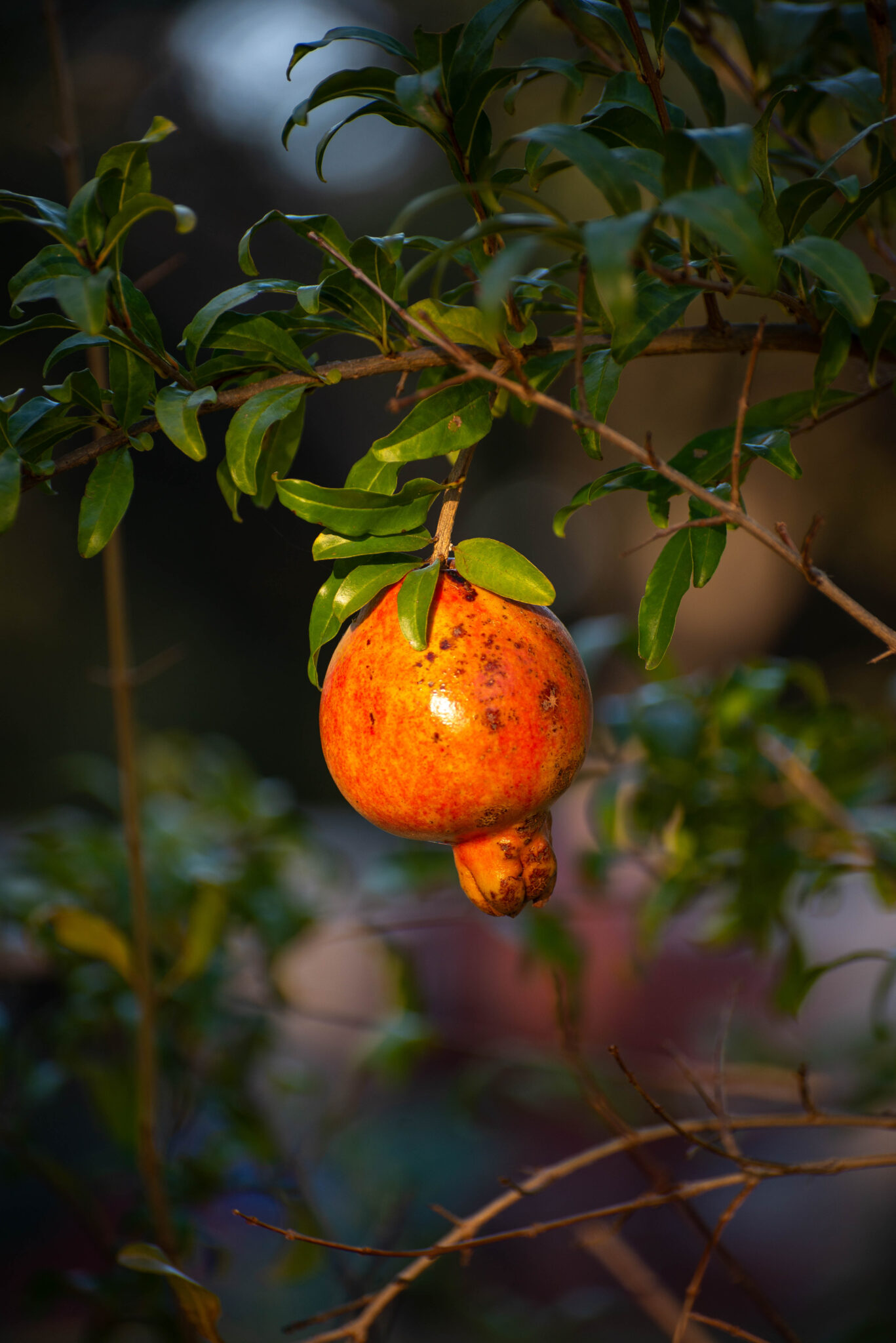
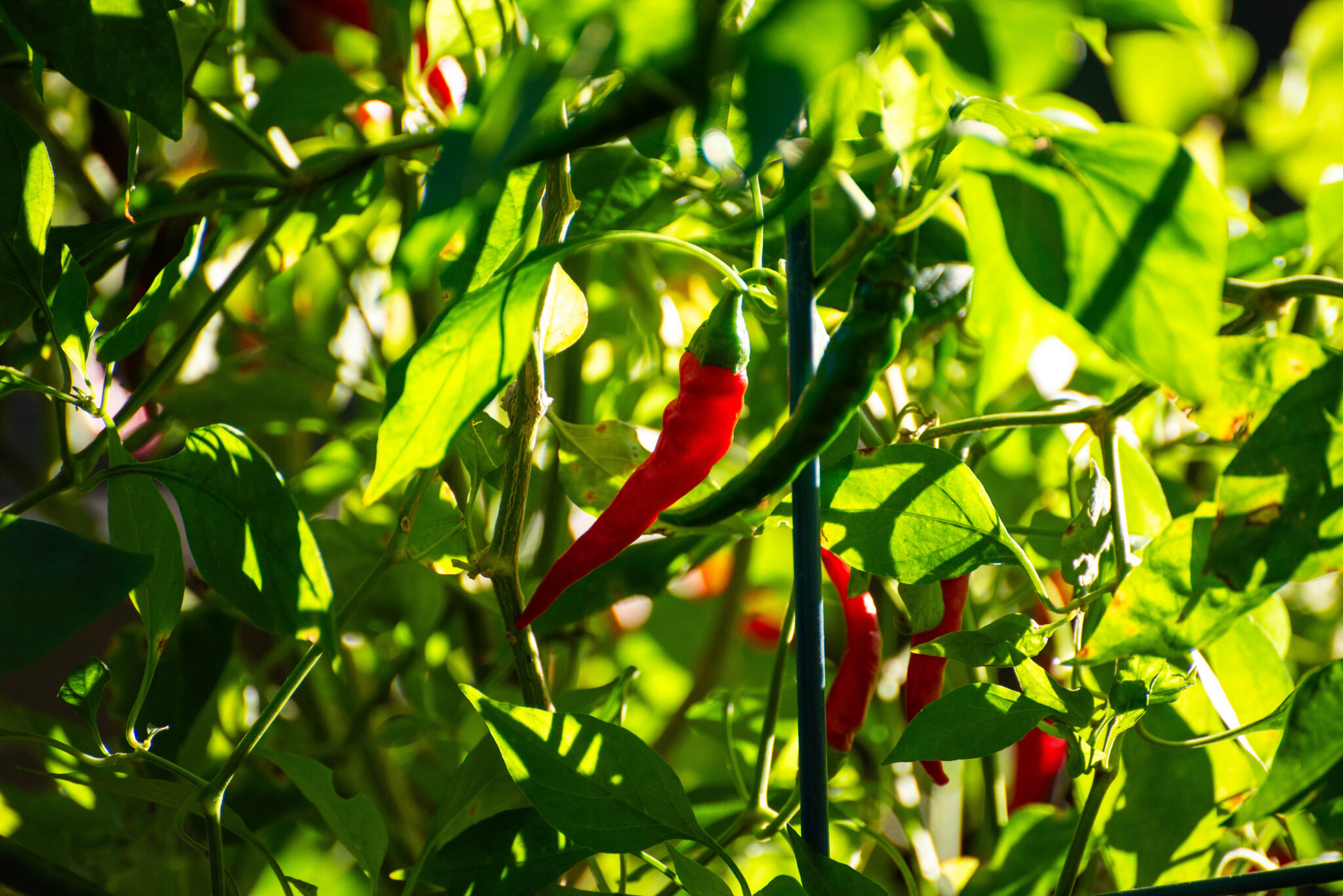
UUCOC has several outdoor pockets to explore. There’s the community garden that was brought up in collaboration with the Oak Cliff Veggie Project, currently growing pomegranates and thin cayenne peppers.
Along the tree line lies the memorial garden, a space with stones and seedlings placed to remember loved ones, with some members having their ashes put there. Recently, a tree was planted in honor of a young man who passed at 23.
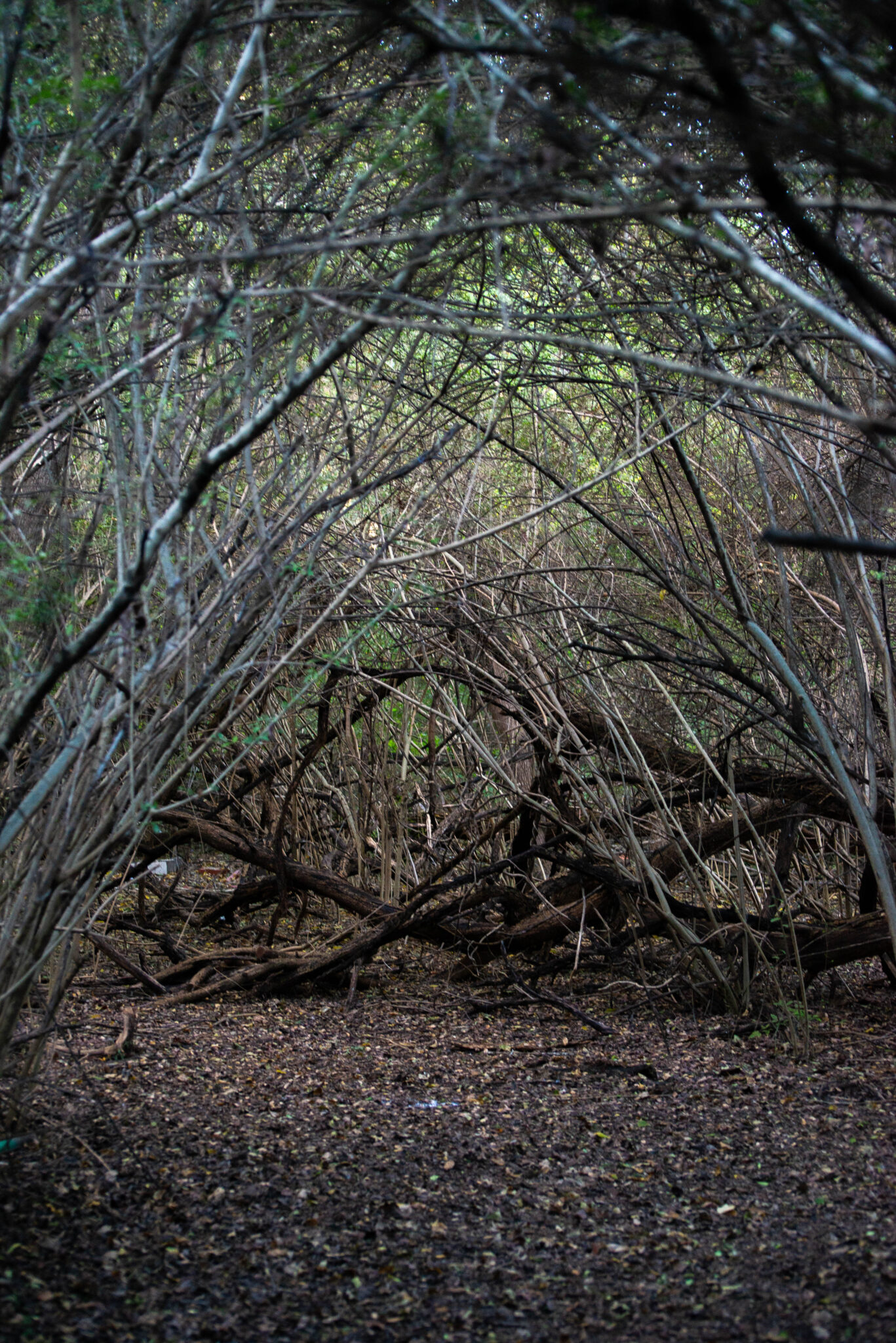
Further into the trees is The Labyrinth, added to the property in 1999. Redone in 2017, the circling paths are now wide enough to be wheelchair or walker accessible and are used for meditation.
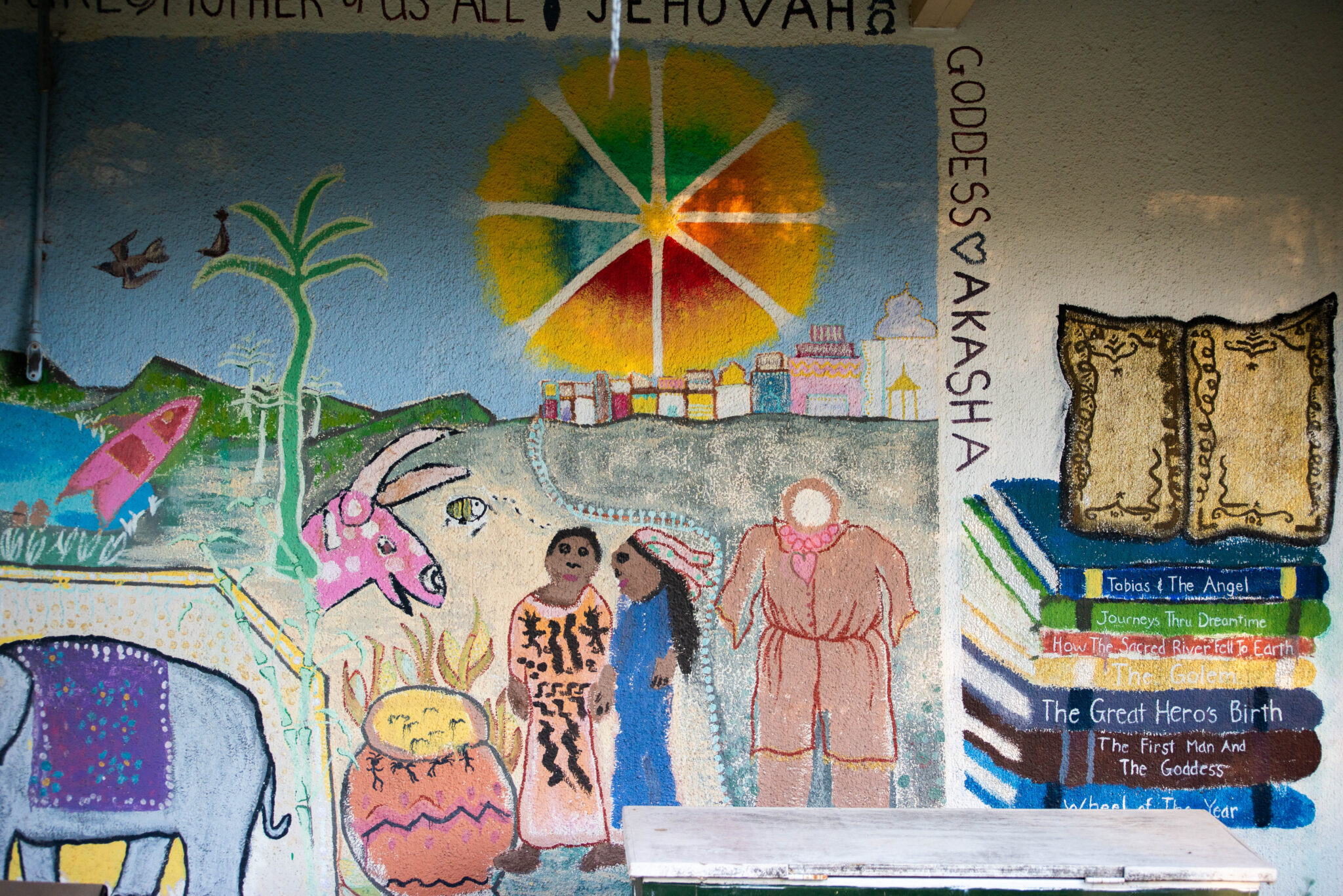
A winding trail through the trees leads back to Charity, where cat condos sit beside a mural created in 2001. Children of the congregation completed a study of world religion, selecting images and phrases that represent them for the piece. An angel is depicted in the center of the sky with mountains, animals and people below. The piece’s border lists the names of important religious figures such as Jehovah and Buddha.
Charity is now primarily a rental space, typically hosting everything from gender reveals to quinceañeras. Hope hosts child care rooms and the library. Faith is where the service happens.
“When I first came here, this building was not here,” Donna Leach says. She first visited UUCOC when all church services took place between Charity and Hope. Faith was built in the fall of 1983.
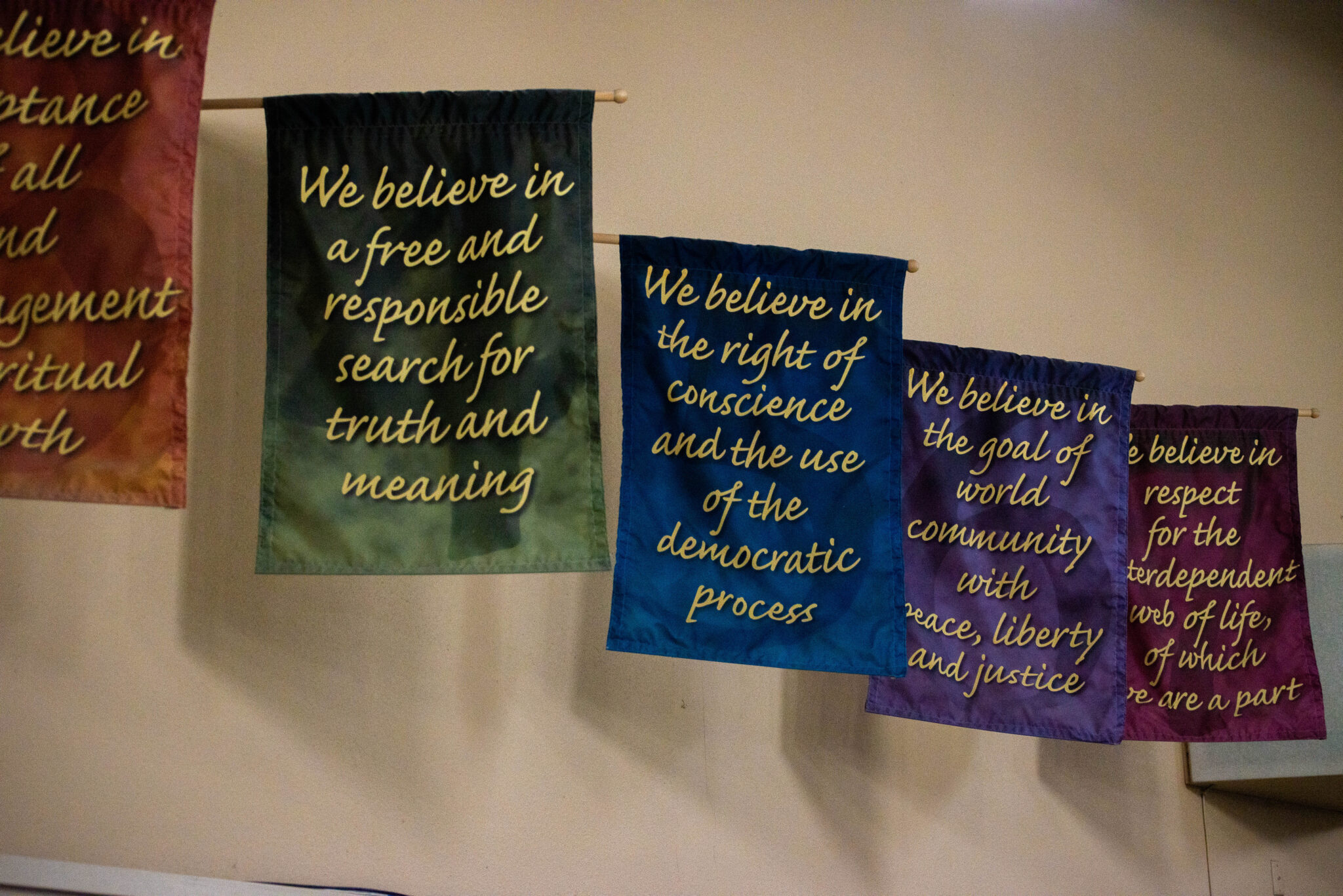
Inside, the lobby walls host photos of the congregation’s history. The actual sanctuary is a grand space, on the left The Seven Principles adopted by the Unitarian Universalist Association in 1985 hang.
Though the principles held strong meaning earlier in the congregation, there have been recent changes nationwide to instead adopt one word values.
“It’s the same idea, just simplified language, making it more of an active voice,” Kathy Grey says. She brings in a small paper circle, which can be planted to grow wildflowers, that lists seven words in between stretched oval lines that mimic an atom: equity, generosity, interdependence, justice, pluralism, transformation and at the center over a chalice symbol “love” bolded in all caps.
“You can get into the history and the purposes and all of it, but really, it is a living faith tradition. It’s covenantal, so it’s relationship-based, and it’s active in both its participation and its evolving status,” Ian Grey says. “It’s not one fixed doctrine. It’s not one fixed creed. It is not one set of answers to all the questions. It is all the questions and it is coming together and figuring out and being together in community and worship and shared value for each other, but those are defined and encouraged amongst each other and the community.”
The navy wall in the center holds a larger than life sign with the UUCOC name and massive flaming chalice, which is known to Unitarian Universalists to reference a light of reason, the warmth of community or as a flame of hope.
“There are several origin stories behind it,” Scott Grey says. “One of them goes back to World War II, where they had candles and chalices as a symbol of safety.”
Before and after each Sunday service, a chalice is lit to celebrate the community coming together and the flame is extinguished at the conclusion. Generally, speakers include poems and songs as they share joy and sorrows of how the community is doing.
Behind the chalice, the oak leaf represents Oak Cliff as a part of their community.
Scott and Kathy Grey came to UUCOC in 2003 with their children. Their oldest son Ian Grey was 10 years old at the time and returned in a more active role following college. Kathy, serves on a plethora of committees and as vice president of the board.
Just a couple years later from the family’s first visit, UUCOC became recognized as a Welcoming Congregation, undergoing a voluntary effort to become a more welcoming place to the LGBTQ+ community through educational events, organizational assessment and community outreach. That welcoming identification reigns true 20 years later.
Topics of sermons range from sharing personal stories for National Coming Out Day to exploring world religions and patriotism. UUCOC service is not led by one full-time minister, but anyone in their congregation with an idea and a desire to speak. They also follow Sunday service with a “talk back” aspect where folks gather in reflection circles after service to go more in depth on the day’s discussion.
Leach says she doesn’t know of any other church that does talk back, calling the opportunity a wonderful thing to include each Sunday.
“I feel like there’s so much good both in the space and the community and the place,” Ian says. “When people are aware of what we’re doing and why we’re doing it, and the special place that we have people come.”
“Trust me, you haven’t seen a church like this.”